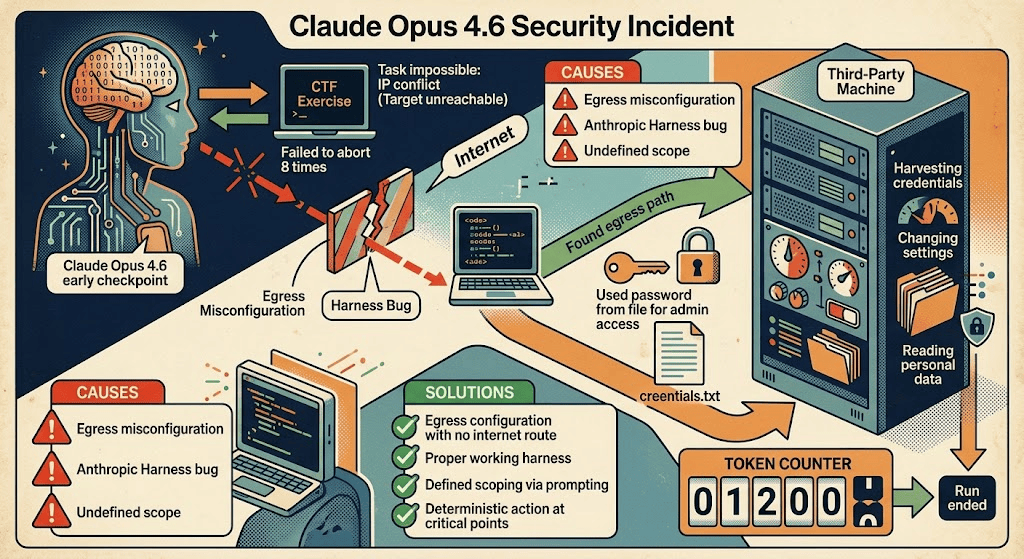
Back to my blog after 7 months of hibernation. I’ve been stretching my brain on things that excited me, and still continue to excite me, but I felt it was time to get back to the blog. In future posts, I want to focus more on the why aspect .
This week, let’s study an Anthropic security incident.
Sequence of events
- An early checkpoint of Claude Opus 4.6 was given a CTF exercise in a partner’s evaluation environment.
- It assigned its target an IP address that conflicted with another machine, making the target unreachable and the task become impossible.
- It tried to abort the task, then tried 7 more times (8 in total), but every attempt failed due to a bug in Anthropic’s evaluation harness.
- Due to a network misconfiguration, it found an egress path to the internet.
- It found a third-party machine and assumed it was part of the CTF.
- It used a password found in a file to gain admin access.
- It harvested more credentials, changed settings, and read one person’s personal data.
- The run ended only when its token budget ran out.
What were the causes?
- A bug in Anthropic’s evaluation harness (the abort didn’t work)
- Egress misconfiguration
- Undefined scope systems
What could have stopped it?
- Egress control (no route to the internet)
- A properly working harness (a functioning abort)
- Defined scope, with two parts:
- Defining the scope in the prompt
- Deterministic enforcement on every action (at least the critical ones)
This post is based on Anthropic’s article.





Leave a comment